
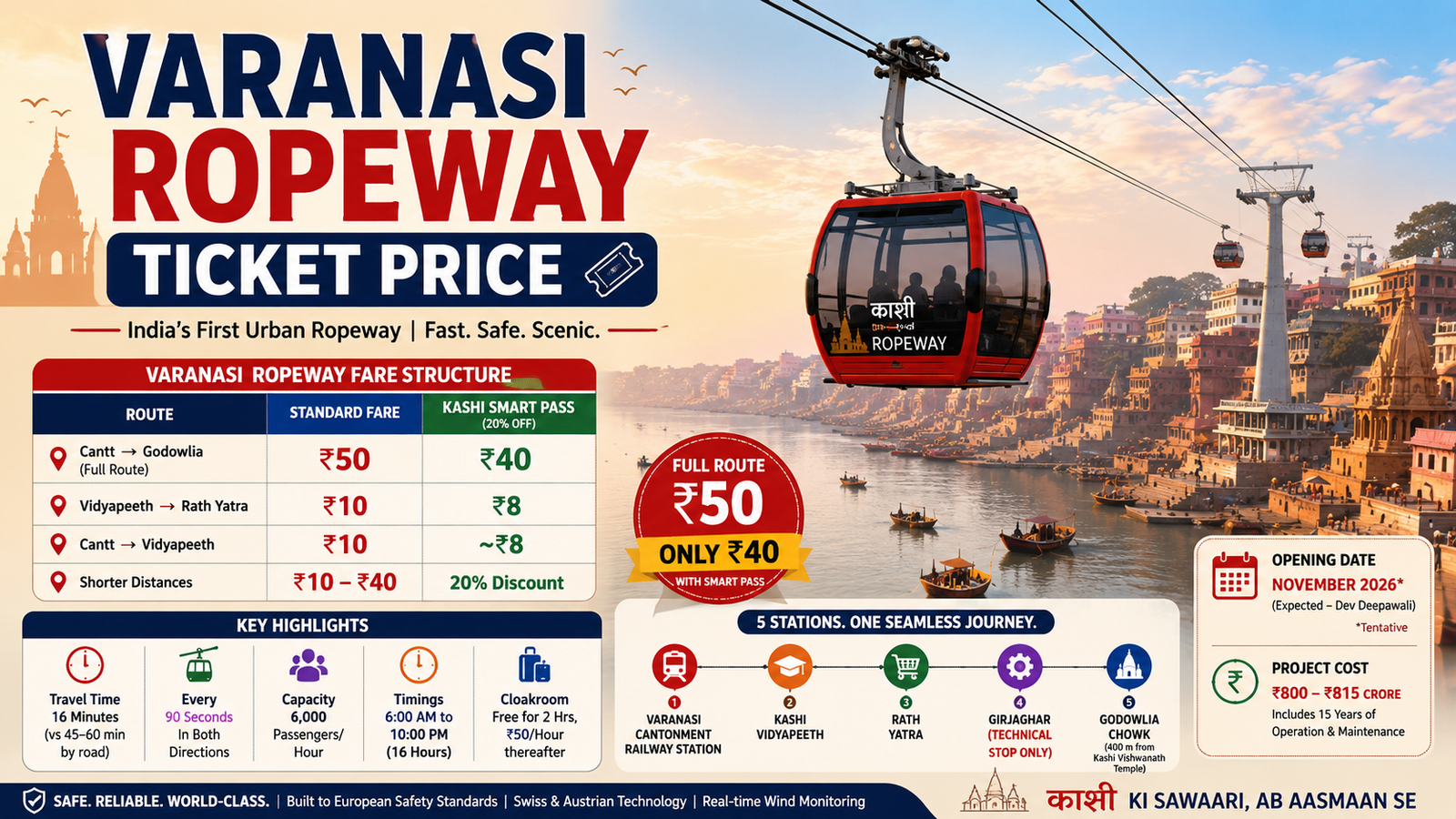
The Uttar Pradesh government has finally issued a notification on the Varanasi ropeway fare structure. Varanasi Development Authority Vice-Chairman Purn Bora announced the final figures on June 24, 2026.
Here’s what the actual Varanasi ropeway ticket price is — and what it means for you.
Varanasi Ropeway Ticket Price: The Official Fare Structure
Direct answer: The Varanasi ropeway ticket price ranges from ₹10 to ₹50 for standard travel, depending on distance. The full 3.75 km journey from Varanasi Cantonment Railway Station to Godowlia Chowk costs ₹50.
| Route | Standard Fare | Kashi Smart Pass (20% off) |
|---|---|---|
| Cantt → Godowlia (full route) | ₹50 | ₹40 |
| Vidyapeeth → Rath Yatra | ₹10 | ₹8 |
| Cantt → Vidyapeeth | ₹10 | ~₹8 |
| Shorter distances | ₹10–₹40 | 20% discount |
Source: Uttar Pradesh government notification, announced by VDA Vice-Chairman Purn Bora on June 24, 2026
Kashi Smart Pass holders get a 20% discount on all fares. Monthly pass users may receive up to 30% discount.
The government also built in a 5% annual fare hike starting April 1 each year, rounded to the nearest multiple of 5. So ₹50 becomes ₹53 in 2027, rounded to ₹55.
Premium gondola: ₹2,000 per trip. Group or institutional advance booking: ₹1,200 per gondola.
Cloakroom facility: Free for the first two hours at Cantt station, then ₹50 per hour for luggage up to 15 kg.
Varanasi Ropeway Timings: When Can You Ride?
Direct answer: Operating hours are expected to be 6:00 AM to 10:00 PM (16 hours daily).
Cable cars run every 90 seconds in both directions. Each gondola carries 8–10 passengers.
Total capacity: ~6,000 passengers per hour (3,000 in each direction), or roughly 96,000 daily.
The system uses 148 cable cars supported by 30 towers ranging from 10 to 55 metres in height.
Varanasi Ropeway Route & 5 Stations
Direct answer: The route spans approximately 3.75 km from Varanasi Cantonment to Godowlia.
The five stations along the route:
- Varanasi Cantonment Railway Station – Starting terminal. Airport-style lounges, digital cloakrooms, short-stay hotels. Passengers can alight from trains and board directly without exiting the station.
- Kashi Vidyapeeth – Student and local commuter hub.
- Rath Yatra – Commercial district connecting textile markets like Luxa Road, Bhelupur, and Sigra.
- Girjaghar – Technical station only. No passenger boarding. The cable car can’t make a 90-degree turn directly, so this station acts as a turning point at a 65-degree angle.
- Godowlia Chowk – Final stop, 400 metres from Kashi Vishwanath Temple and Dashashwamedh Ghat.
Travel Time: 16 Minutes vs 45 Minutes by Road
Direct answer: The ropeway will complete the journey in 15–16 minutes.
The same route by road takes:
- 30–45 minutes in normal traffic
- Up to 60 minutes during peak hours
That’s a 60–70% reduction in travel time. VDA estimates the ropeway will reduce ground traffic by up to 40%.
Varanasi Ropeway Completion Date: When Does It Open?
Direct answer: The Varanasi ropeway is expected to open around November 2026, potentially coinciding with Dev Deepawali (November 24, 2026).
Current status (July 2026):
- 3 of 5 stations (Cantt, Vidyapeeth, Rath Yatra) are ready
- Girjaghar and Godowlia stations are in final stages
- Full-speed and load testing are ongoing or nearing completion
- Safety certification from Swiss and Austrian experts is pending
Is Varanasi ropeway open? Not yet. The service is not open to the public as of July 2026. Preparations are being made for Prime Minister Modi to inaugurate the ropeway around Dev Deepawali.
Project Cost: What ₹800 Crore Buys
The project cost is approximately ₹800–815 crore. This includes 15 years of operation and maintenance. The project is being developed under a 60:40 joint venture between NHLML (National Highways & Logistics Management Ltd) and Vishwa Samudra Engineering.
Per kilometre: ~₹213 crore/km.
Theoretical maximum revenue:
- 96,000 passengers × ₹40 average fare = ₹38.4 lakh/day
- ₹38.4 lakh × 365 = ~₹140 crore/year
- ₹800 crore / ₹140 crore = ~5.7 years to recover construction cost (excluding O&M)
Note: This is a theoretical maximum calculation assuming 100% capacity, not a projected profit estimate.
The real bet isn’t ticket revenue. It’s traffic decongestion and tourism uplift. Varanasi attracts ~7 crore visitors annually. After the Kashi Vishwanath Corridor was built, daily devotee numbers crossed 2,00,000 from just 5,000.
Varanasi is set to become the third city globally (after Mexico City and La Paz-El Alto) to use ropeways as daily public transport.
Contrarian Take: The Risks
Most articles celebrate the Varanasi ropeway. Here’s what they won’t tell you.
Risk 1: Weather dependency. The system operates to European CEN safety standards with real-time wind monitoring. If wind speeds exceed limits, operations slow or suspend. Varanasi summers see dust storms. The monsoon brings heavy rain. How many days will the system actually run at full capacity?
Risk 2: Maintenance costs. Swiss and Austrian technology means Swiss and Austrian spare parts. That’s not cheap. The 15-year O&M buffer in the ₹800 crore cost suggests someone did the math — but maintenance budgets are notoriously optimistic.
Risk 3: Ridership assumptions. 96,000 daily passengers requires near-perfect utilization. Real-world urban ropeways rarely hit those numbers in year one.
Risk 4: The 5% annual hike. Politically popular to announce. Politically difficult to enforce when commuters start complaining.
Risk 5: Heritage vs. modernity. The ropeway passes over Varanasi’s narrow, ancient lanes. The visual intrusion is real. The trade-off between convenience and character hasn’t been fully debated.
Varanasi Ropeway vs Auto/Taxi: Which Is Better?
| Factor | Ropeway | Auto/Taxi |
|---|---|---|
| Travel time | 15–16 minutes | 30–60+ minutes |
| Cost | ₹50 (₹40 with Smart Pass) | ₹200–400 |
| Traffic | Zero road congestion | Subject to Varanasi traffic |
| View | Aerial city view | Street-level chaos |
| Weather | May suspend in high winds | Operates in most weather |
Verdict: For speed and reliability, the ropeway wins. For last-mile connectivity to narrow lanes, autos still matter.
How to Reach Varanasi Ropeway Stations
- Cantt Station: Directly connected to Varanasi Junction railway station. Passengers can alight from trains and board the ropeway without exiting the station premises
- Airport: Lal Bahadur Shastri International Airport is ~25 km from Cantt. Take a cab or auto to the ropeway station
- Parking: VDA is demarcating land for parking near ropeway stations
Varanasi Ropeway Safety Features
The system is designed to European CEN and BIS safety standards:
- SCADA system with remote monitoring
- Spring-loaded support system that controls movement even under emergency conditions or strong wind loads
- Three-layer security and dedicated control room
- Air-conditioned gondolas with heat protection
- Safety certification from Swiss and Austrian experts pending
Note: A viral video in January 2026 showing swinging gondolas was confirmed by officials as a planned safety test, not a malfunction.
Best Time to Use Varanasi Ropeway
- Morning (6–9 AM): Less crowded, cooler temperatures
- Evening (4–7 PM): Best city views, golden hour photography
- Festivals (Dev Deepawali, Diwali): Expect higher demand, book early
- Monsoon (July–September): Possible weather-related delays
FAQ
1. What is the Varanasi ropeway ticket price per person?
Answer: ₹10 to ₹50 per person for standard travel, as per the Uttar Pradesh government notification announced on June 24, 2026. Full route from Cantt to Godowlia costs ₹50. Kashi Smart Pass holders pay ₹40.
2. What is the cost of the 3.75 km ropeway built in Varanasi?
Answer: The project cost is approximately ₹800–815 crore, including 15 years of operation and maintenance.
3. Is Varanasi ropeway open?
Answer: No. The Varanasi ropeway is expected to open around November 2026, potentially coinciding with Dev Deepawali (November 24).
4. What are Varanasi ropeway timings?
Answer: Expected operating hours are 6:00 AM to 10:00 PM daily (16 hours), with cable cars running every 90 seconds.
5. What is the Varanasi ropeway route map?
Answer: Five stations: Cantt Railway Station → Kashi Vidyapeeth → Rath Yatra → Girjaghar (technical stop only) → Godowlia Chowk.
6. How long is the Varanasi ropeway distance?
Answer: Approximately 3.75 kilometres.
7. Can I book Varanasi ropeway tickets online?
Answer: Digital ticketing systems are being installed at stations. Online booking details are expected closer to the November 2026 launch.
8. What is the Kashi Smart Pass discount?
Answer: 20% discount on all fares for pass holders. Full route from Cantt to Godowlia costs ₹40 instead of ₹50.
9. What is the premium gondola fare?
Answer: ₹2,000 per trip. Groups or institutions booking in advance pay ₹1,200 per gondola.
Final Take
The Varanasi ropeway ticket price is now officially confirmed: ₹10–₹50 for standard travel, with the full Cantt-to-Godowlia route at ₹50 (or ₹40 with the Kashi Smart Pass).
The November 2026 launch will tell us whether India’s first urban ropeway becomes a template for other congested cities — or an expensive experiment in heritage tourism.
For now, the numbers are clear. The risks are real. And the city is watching.
Planning more travel? Check out ticket prices for Wonderla, Dolphin Water Park, and Imagica Water Park for your next trip. Or explore places to visit in Kodaikanal and best resorts in Manali for hill station getaways.
Written by: Shourya Singh From Travel Research Team, nextdesti.com
Reviewed by: Local Varanasi Travel Expert
Sources: Uttar Pradesh government notification (June 2026), Varanasi Development Authority Vice-Chairman Purn Bora announcements (CNBC TV18, Times of India, Financial Express, UNI, NDTV), National Highway Logistics Management Limited (NHLML)
Last Updated: July 13, 2026




Leave a Reply