
Forget the ₹4,800 teaser fares you see on billboards. By the time you factor in surge pricing, the ₹399 fuel surcharge, and whatever the airline’s algorithm decides your desperation level is, the real number for a Mumbai–Delhi ticket in August 2026 is rarely what it says on the tin.
This isn’t just about supply and demand. It’s about ATF at ₹115 per litre, a new airport at Navi Mumbai stealing market share, and a government that removed fare caps three months ago. Each variable is pulling prices in a different direction—which makes predicting ticket costs a game of chess, not roulette.
Below, we break down exactly what you will pay right now, why the weekend premium is a scam, and how to spot a genuine deal versus a marketing mirage.
The Baseline: What Does a Mumbai to Delhi Flight Ticket Price?
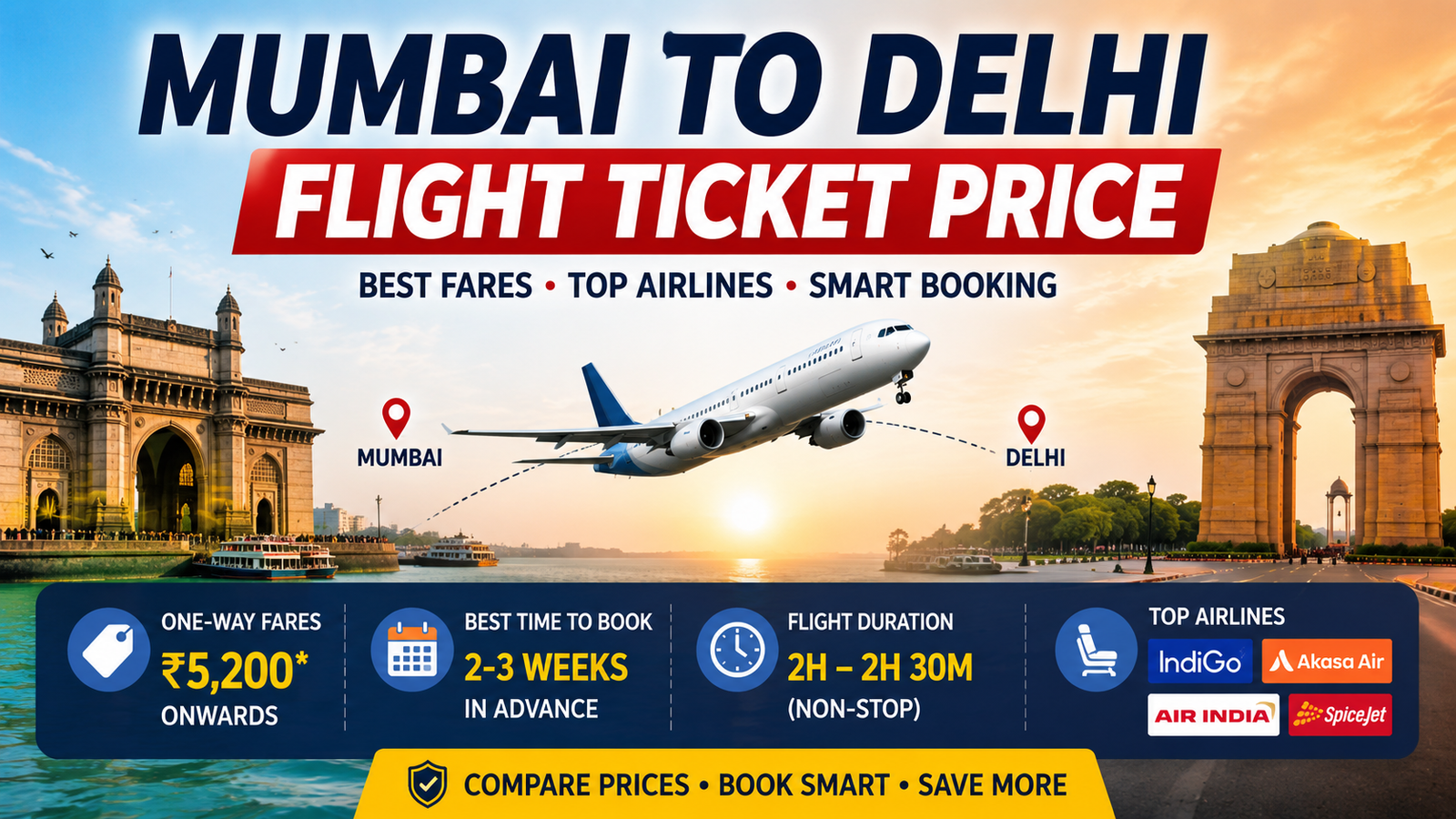
If you book two to three weeks in advance on a standard weekday, expect to pay somewhere between ₹5,200 and ₹7,500 for a one-way economy ticket on the Mumbai (BOM) to Delhi (DEL) route.
That’s the ideal scenario. Current listings show one-way fares starting around ₹4,800 on platforms like EaseMyTrip, with IndiGo and Akasa Air frequently offering competitive rates in the ₹5,200–₹5,700 range.
| Airline | Typical Base Fare (INR) | Baggage Allowance | Meals Included | Refund Flexibility |
|---|---|---|---|---|
| Akasa Air | ₹5,100 – ₹6,800 | 7kg cabin + 15kg check-in | No (buy onboard) | Limited, fees apply |
| IndiGo | ₹5,200 – ₹7,200 | 7kg cabin + 15kg check-in | No | Strict, high fees |
| SpiceJet | ₹5,500 – ₹7,000 | 7kg cabin + 15kg check-in | No | Varies by fare type |
| Air India | ₹6,600 – ₹8,500+ | 7kg cabin + 15-25kg check-in | Yes | More flexible |
| Air India Express | ₹5,200 – ₹6,700 | 7kg cabin + 15kg check-in | No | Limited |
Data compiled from airline fare listings
Akasa Air frequently runs the lowest entry-level pricing. IndiGo, despite being the market leader, isn’t always the cheapest—their base fares often start higher than Akasa’s for the same route.
One-way vs round-trip: Booking a return often works out cheaper per leg. The system rewards commitment.
The Macro View: Why This Route Is Different
The Mumbai-Delhi corridor isn’t just another domestic route. It’s India’s busiest aviation artery—business executives, government officials, and holiday travelers move between the financial capital and political capital every single day.
That consistent demand creates a pricing floor. Even in off-peak periods, you won’t see fire-sale prices because the route always has passengers.
Distance: Approximately 1,150 km by air. Flight time: 2 hours to 2 hours 30 minutes direct.
Why Are Mumbai-Delhi Flights So Costly Right Now?
1. Fuel Costs Are the Primary Driver
Aviation Turbine Fuel (ATF) accounts for 40–60% of an airline’s operating costs. The Middle East conflict pushed international ATF prices up 2.5 times—from ₹60.5 per litre in March 2026 to ₹142 per litre in May 2026.
As of August 1, 2026, Indian Oil Corporation raised domestic ATF prices by ₹5 per litre, bringing the rate to ₹115 per litre. This directly impacts ticket prices.
To shield passengers from further volatility, the government approved a ₹10,000 crore ATF stabilisation fund in June 2026, allowing airlines to buy fuel at a fixed price of ₹86.32 per litre for up to three years. However, this benefit hasn’t fully filtered through to fares yet.
2. The Tax Situation Is Shifting
Aviation fuel isn’t under GST. Each state sets its own VAT rate—historically ranging from 4% to 30%.
In May 2026, both Maharashtra and Delhi slashed VAT on ATF:
- Maharashtra: Reduced VAT from 18% to 7%, effective May 15, 2026, until November 14, 2026
- Delhi: Reduced VAT from 25% to 7%, effective May 16, 2026
This six-month relief provides some cost buffer, but airlines are still recovering from months of elevated expenses.
3. Fare Caps Were Removed
In December 2025, after IndiGo’s operational meltdown sent Mumbai-Delhi fares soaring, the government imposed price caps. Routes between 1,000–1,500 km—including Delhi-Mumbai—were capped at approximately ₹15,000–₹18,000 one-way.
Those caps were removed on March 23, 2026. The Ministry of Civil Aviation noted that the “prevailing situation has since stabilised, with restoration of capacity and normalisation of operations across the sector”.
Airlines now have pricing freedom again. That means surge pricing is back. The upside? More competitive base fares during low-demand periods. The downside? When things go wrong, they go really wrong.
4. Air India’s Fuel Surcharge
Air India introduced a ₹399 fuel surcharge on domestic flights for all new bookings made from March 12, 2026. Other airlines are expected to follow if ATF prices remain elevated.
The New Player: Navi Mumbai Airport (NMI)
This is the wildcard that changes the equation.
Navi Mumbai International Airport commenced commercial operations on December 25, 2025. Multiple carriers now operate daily Delhi services from NMI:
- Air India Express: Daily Delhi flights from December 25, 2025, increasing to daily operations from January 1, 2026
- Akasa Air: Direct flights to Delhi starting December 25, 2025
- IndiGo: Delhi route operational from December 25, 2025
The contrarian insight: Navi Mumbai tickets are often cheaper despite higher airport charges. Why? Airlines are using lower base fares to attract traffic to the new airport.
This arbitrage opportunity won’t last forever. Once passenger traffic stabilises at NMI, the pricing gap will narrow. But for now, savvy travelers should check both BOM and NMI departure options.
When Is the Cheapest Time to Fly?
Cheapest day: Tuesday consistently offers the lowest fares. Weekend departures—especially Friday and Sunday evenings—command a premium. Friday is typically the most expensive day.
Cheapest month: September is the most affordable month for round-trip fares. July tends to be more expensive.
Cheapest time of day: Early morning flights (before 7 AM) and late-night red-eyes are cheaper than peak business hours (8–10 AM, 5–7 PM).
Booking window: 2–3 weeks ahead is the optimal window. Booking 8–12 weeks ahead during peak festival periods can save 30–40% compared to last-minute purchases.
Emergency Tickets: The Cost of Panic
Book within 24–48 hours of departure? You’re paying a premium.
Last-minute economy tickets generally start around ₹7,200 and can jump past ₹11,000 depending on seat availability.
During the December 2025 IndiGo crisis, fares hit extreme levels. The fare caps were introduced precisely because of that volatility.
Pro tip: If you absolutely must book last-minute, check both BOM and NMI departure airports. The price difference can be substantial.
The Cheapest Way to Travel from Mumbai to Delhi
Flights are the fastest option, but they’re not always the cheapest.
| Mode | Duration | Cost Range (INR) | Best For |
|---|---|---|---|
| Flight | 2–2.5 hours | ₹5,200–₹8,500+ | Business travelers, time-sensitive trips |
| Train | 16+ hours | ₹1,500–₹4,000 | Budget travelers with flexible schedules |
| Bus | 24+ hours | ₹2,000–₹5,000 | Tight budgets, no time constraints |
The cheapest way is train—but the best value for most travelers is a flight booked 2–3 weeks in advance.
Strategic Takeaways: How to Beat the System
- Book 2–3 weeks ahead. This is the sweet spot. Booking 3+ months out rarely gets you the lowest fare because airlines haven’t started discounting yet.
- Check both BOM and NMI. Navi Mumbai airport is offering competitive base fares right now. Compare both before booking.
- Fly Tuesday. Weekend premiums are real. If you can shift your travel by a day, you’ll save 15–25%.
- Choose morning flights over evening. Peak business hours cost more. Early birds get cheaper seats.
- Akasa Air for budget, Air India for service. Akasa consistently offers the lowest entry prices. Air India provides meals and better baggage allowance, but you’ll pay ₹1,000–₹1,500 more.
- Factor in the fuel surcharge. Air India’s ₹399 surcharge is now standard. Other airlines may follow.
Risk Assessment: What Could Go Wrong?
Upside scenario: Fares could drop if ATF prices cool and the ₹10,000 crore stabilisation fund delivers savings to airlines. The temporary VAT cuts in Delhi and Maharashtra (until November 2026) provide some downside protection.
Downside scenario: Geopolitical escalation in the Middle East could send fuel prices higher. Air India’s capacity reductions could tighten the market. And with fare caps removed, there’s no ceiling on surge pricing during disruptions.
My assessment: Prices will remain volatile through 2026. The floor is around ₹5,000; the ceiling is whatever the market will bear during a crisis. Book early, stay flexible, and always have a backup plan.
FAQ
Q: What is the average Mumbai to Delhi flight ticket price in 2026?
A: For a standard one-way economy ticket booked 2–3 weeks in advance, expect ₹5,200–₹7,500. Last-minute bookings can push this to ₹7,200–₹11,000+.
Q: Which day is the cheapest to fly from Mumbai to Delhi?
A: Tuesday typically offers the lowest fares. Weekend departures—especially Friday and Sunday evenings—are significantly more expensive.
Q: Why are Mumbai-Delhi flights so expensive right now?
A: High ATF prices (₹115 per litre as of August 2026), the removal of government fare caps, Air India’s ₹399 fuel surcharge, and reduced capacity from some carriers.
Q: Is Navi Mumbai airport cheaper than Mumbai airport for Delhi flights?
A: Yes, currently. Airlines are using lower base fares to attract traffic to NMI, which opened on December 25, 2025. Compare both BOM and NMI before booking.
Q: What’s the cheapest way to travel from Mumbai to Delhi?
A: Train is the cheapest (₹1,500–₹4,000, 16+ hours). But for value, a flight booked 2–3 weeks ahead at ₹5,200–₹7,500 is the best balance of cost and time.
Q: How far in advance should I book a Mumbai-Delhi flight?
A: 2–3 weeks is the optimal window. Booking 8–12 weeks ahead during peak festival periods can save 30–40% vs last-minute.
Q: What is the flight time from Mumbai to Delhi?
A: Direct flights take 2 hours to 2 hours 30 minutes.
Conclusion
The Mumbai-Delhi route is a case study in dynamic pricing. Demand is consistent, costs are volatile, and airlines are ruthless about maximising yield.
Your move: Book 2–3 weeks out. Fly Tuesday. Check both BOM and NMI. Consider Akasa Air for budget travel. And always—always—have a buffer in your budget for the unexpected.
The cheapest ticket isn’t always the best ticket. Sometimes paying ₹1,000 more for a convenient time or a better airline saves you more in the long run.
Do the math. Make the call. And don’t complain when the market does what markets do.
Looking for more travel insights? Check out our guides on places to visit in Kodaikanal, best resorts in Manali, and Agra to Jaipur ticket prices.
Planning other trips? Explore ticket prices for Wonderla, Dolphin Water Park, Taj Mahal, or Ahmedabad to London flights.
For more upcoming updates about hotels, trains, cruises, flights, destinations, holiday plans & tour packages, explore our NextDesti for all.






Leave a Reply