
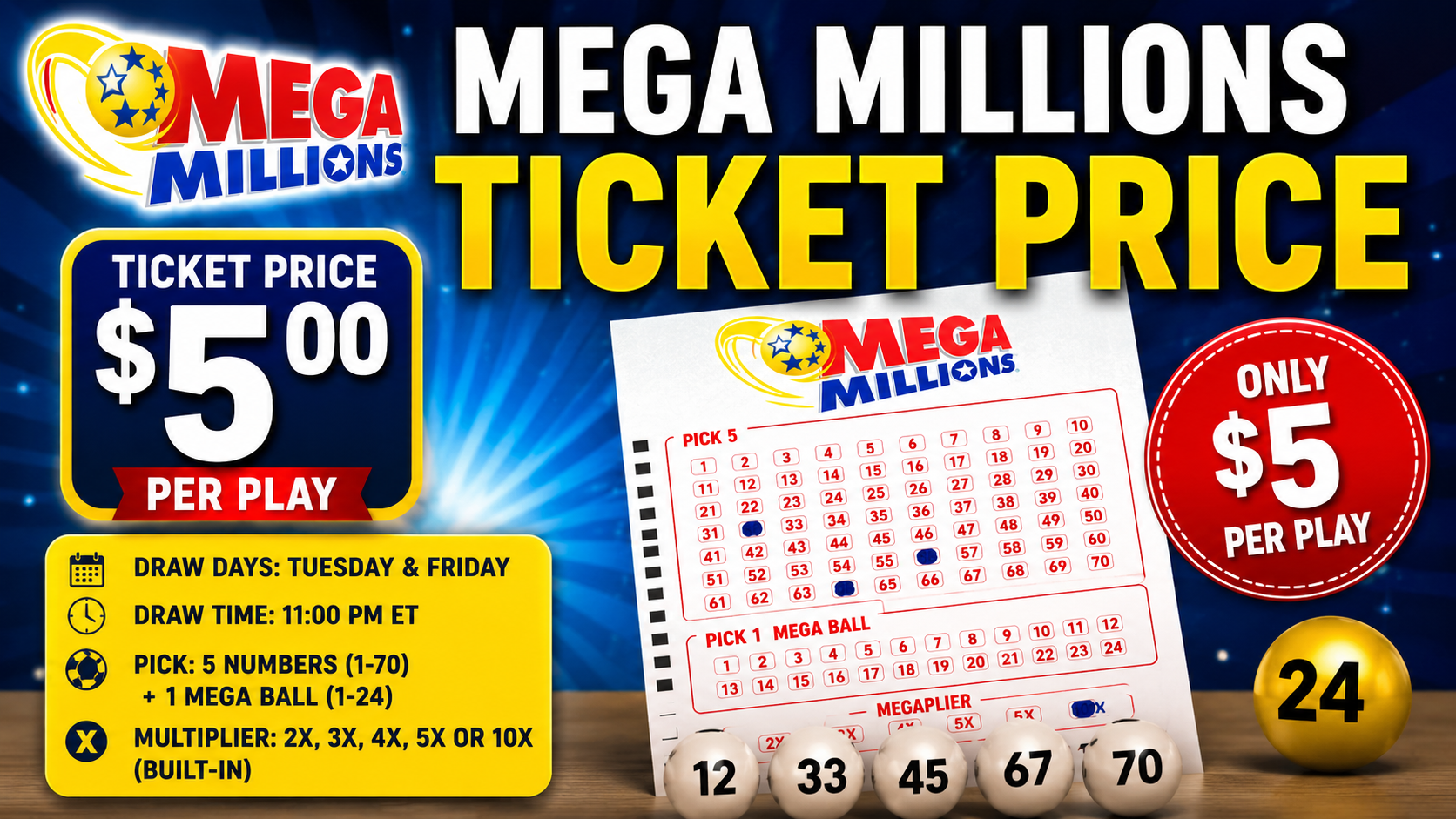
Mega Millions tickets cost $5.00 per play in 2026. That is the short answer. The longer answer involves a 150% price increase, a built-in multiplier, slower-than-expected jackpot growth, and a measurable decline in sales across key markets.
Here is what you actually need to know — the numbers, the payouts, the odds, and the data that tells the real story.
Quick Facts: Mega Millions Ticket Price 2026
| Item | Value |
|---|---|
| Ticket Price | $5.00 per play |
| Draw Days | Tuesday & Friday at 11:00 PM ET |
| Jackpot Odds | 1 in 290,472,336 |
| Minimum Jackpot | $50 million |
| White Balls | 5 numbers from 1 to 70 |
| Mega Ball | 1 number from 1 to 24 |
| Multiplier | Built-in (2X, 3X, 4X, 5X, or 10X) |
| Participating Jurisdictions | 47 (45 states + D.C. + U.S. Virgin Islands) |
| States That Do NOT Participate | Alabama, Alaska, Hawaii, Nevada, Utah |
Mega Millions tickets are available in 47 localities: 45 states, the District of Columbia, and the U.S. Virgin Islands. The only states where you cannot buy a ticket are Alabama, Alaska, Hawaii, Nevada, and Utah.
Drawings are held every Tuesday and Friday at 11:00 PM ET. The cutoff for ticket sales is 9:50 PM ET on draw nights.
How Much Is a Mega Millions Ticket in 2026?
A single Mega Millions play costs $5.00. This is the same price in every participating state, including Florida, California, Texas, and New York.
The $5 ticket includes a built-in multiplier that is randomly assigned at the time of purchase. The multiplier can be 2X, 3X, 4X, 5X, or 10X and applies to all non-jackpot prizes. There is no longer a separate $1 add-on for the Megaplier — it is now included in the base price.
Players choose five numbers from 1 to 70 (the white balls) and one number from 1 to 24 (the gold Mega Ball). Alternatively, you can select Easy Pick or Quick Pick to have numbers randomly generated for you.
Half of the proceeds from each Mega Millions ticket sale remains in the state where the ticket was sold, supporting designated good causes and retailer commissions.
Mega Millions Prize Chart & Payout Structure (2026)
There are nine ways to win in Mega Millions, with prizes ranging from $10 to the jackpot. The built-in multiplier increases non-jackpot prizes as follows:
| Match | Base Prize | With 10X Multiplier | Odds |
|---|---|---|---|
| 5 white balls + Mega Ball | Jackpot | Jackpot | 1 in 290,472,336 |
| 5 white balls | $2,000,000 | $10,000,000 | 1 in 12,629,232 |
| 4 white balls + Mega Ball | $20,000 | $100,000 | 1 in 893,761 |
| 4 white balls | $1,000 | $5,000 | 1 in 38,859 |
| 3 white balls + Mega Ball | $400 | $2,000 | 1 in 13,965 |
| 3 white balls | $20 | $100 | 1 in 607 |
| 2 white balls + Mega Ball | $20 | $100 | 1 in 665 |
| 1 white ball + Mega Ball | $14 | $70 | 1 in 86 |
| 0 white balls + Mega Ball | $10 | $50 | 1 in 35 |
Source: Mega Millions official prize matrix
The multiplier odds are: 2X (1 in 2.13), 3X (1 in 3.2), 4X (1 in 8), 5X (1 in 16), and 10X (1 in 32).
Important: Mega Millions has no breakeven prizes — every winning ticket pays $10 or more.
Jackpot Payout: Lump Sum vs. Annuity
If you win the Mega Millions jackpot, you have two payout options:
Annuity Option: The jackpot is paid as one immediate payment followed by 29 annual payments. Each payment is 5% larger than the previous one, which helps protect against inflation. For a $50 million starting jackpot, the initial payment would be approximately $752,000, growing to about $3.1 million in the final year.
Cash Option: A one-time, lump-sum payment equal to the cash in the Mega Millions jackpot prize pool. This is typically about 40-45% of the advertised jackpot. For example, a $743 million jackpot has a cash option of approximately $323.4 million.
Most winners choose the cash option, but the annuity provides guaranteed income for three decades with built-in inflation protection.
Why Did the Mega Millions Ticket Price Increase?
The Mega Millions ticket price increased from $2 to $5 on April 5, 2025. This was only the second price adjustment in the game’s history — the first was in 2017 when tickets increased from $1 to $2.
The stated goals of the price increase were:
- Generate larger jackpots faster
- Increase the minimum prize from $2 to $10
- Improve the odds of winning slightly by removing one Mega Ball (from 25 to 24)
- Raise the starting jackpot after a win from $20 million to $50 million
- Create more “lottery fever” with more frequent billion-dollar prizes
The Mega Millions Consortium estimated that the average jackpot would exceed $800 million, with $1 billion+ prizes becoming more frequent.
How Did the Price Increase Affect Sales?
The data tells a clear story. In the year following the April 2025 changes:
| Metric | Before (April 2024–April 2025) | After (April 2025–April 2026) |
|---|---|---|
| Massachusetts Sales | $111,265,602 | $85,006,745 |
| Sales Change | — | Down 24% |
Massachusetts Lottery sales dropped by 24% in the year following the change. Total prize money won by players increased by 6% to $15.1 million, but that was cold comfort for a lottery that saw overall sales down $33 million through the first eight months of Fiscal Year 2026.
In New York, the numbers were even more dramatic. Mega Millions ticket sales fell from approximately 1.9 million tickets per drawing ($3.8 million) to about 560,000 tickets ($2.8 million) — a drop of roughly two-thirds.
The Feedback Loop Problem
A working paper from economists at UC San Diego, Boston College, and NYU analyzed retailer-level data from approximately 13,800 convenience stores. Their findings:
- Mega Millions revenue dropped between 23% and 28%
- The optimal price point, according to their models, would have been between $3.30 and $3.90
- Roughly half of the revenue drop was caused by a feedback loop: fewer tickets sold → slower jackpot growth → less media attention → even fewer buyers
Massachusetts Lottery Executive Director Mark William Bracken acknowledged the core problem: “The single most important factor in Mega Millions sales is the size of the jackpot.” Since the changes, the Mega Millions jackpot has not crossed $1 billion — the highest was $980 million in November 2025.
Where Did the Money Go?
Interestingly, the economists found that the money not spent on Mega Millions did not shift to Powerball, scratch-off tickets, or online gambling in any measurable way. It stayed in consumers’ pockets — suggesting genuine demand destruction rather than substitution.
Mega Millions vs. Powerball: The $3 Gap
Powerball tickets still cost $2 in 2026. Mega Millions costs $5. That $3 difference is not trivial for the impulse buyer at the convenience store counter.
| Game | Ticket Price | Jackpot Odds |
|---|---|---|
| Mega Millions | $5.00 | 1 in 290,472,336 |
| Powerball | $2.00 | 1 in 292,201,338 |
Powerball has maintained its $2 price point, and with a comparable jackpot structure, it remains the lower-friction purchase for casual players. Mega Millions now competes with a sandwich, a coffee, or a streaming subscription — a higher barrier to entry that the sales data suggests many players are simply unwilling to cross.
Who Plays the Lottery the Most?
Lottery play is not evenly distributed across income levels. Research consistently shows that lower-income groups play at higher rates and spend a higher percentage of their income on lottery games compared to wealthier individuals.
A $3 price increase on a ticket is a small absolute number but a meaningful relative increase for the demographic that plays the most. Making the product more expensive does not make it more equitable — it simply extracts more from the same people or, as the data shows, pushes them out of the market entirely.
Meanwhile, younger demographics (Gen Z and Millennials) are increasingly active in gambling overall — 34% and 42% respectively — but these are not necessarily the same people buying lottery tickets. The lottery’s core audience remains older, lower-income, and more price-sensitive.
Frequently Asked Questions
1. How much is a Mega Millions ticket in 2026?
Answer: A Mega Millions ticket costs $5.00 per play in all participating states. This includes a built-in multiplier for non-jackpot prizes. There is no separate Megaplier add-on.
2. Why did the Mega Millions ticket price increase?
Answer: The price increased from $2 to $5 in April 2025 to generate larger jackpots faster, increase lower-tier prizes, and improve the overall player experience. It was only the second price increase in the game’s history.
3. What are the odds of winning the Mega Millions jackpot?
Answer: The odds of matching all six numbers are 1 in 290,472,336.
4. How is the Mega Millions jackpot paid out?
Answer: Winners can choose between a lump-sum cash payment (approximately 40-45% of the advertised jackpot) or an annuity paid in 30 installments over 29 years, with each payment 5% larger than the previous one.
5. Can I buy Mega Millions tickets online?
Answer: This depends on your state. Some states, such as Virginia, allow online ticket purchases through their official lottery apps or websites. Check with your state lottery for specific rules.
6. Which states participate in Mega Millions?
Answer: Mega Millions is available in 45 states, plus Washington D.C. and the U.S. Virgin Islands — a total of 47 jurisdictions. The only non-participating states are Alabama, Alaska, Hawaii, Nevada, and Utah.
7. What happens if multiple winners share the jackpot?
Answer: The jackpot prize is shared equally among all winning tickets that match all six numbers.
8. Is the multiplier included in the $5 ticket?
Answer: Yes. Every $5 ticket includes a randomly assigned multiplier (2X, 3X, 4X, 5X, or 10X) that applies to all non-jackpot prizes.
The Bottom Line
The Mega Millions ticket price is $5 in 2026. The price increase was intended to create faster-growing jackpots and more billion-dollar prizes, but the data shows a different story: sales are down 24% in Massachusetts, roughly two-thirds in New York, and overall revenue has dropped 23-28% according to academic analysis.
For players, the expected value of a lottery ticket remains negative — that is the nature of the game. But the $5 price point makes it significantly more expensive to buy into the fantasy. For states that rely on lottery revenue, the new pricing strategy has not delivered the promised returns.
The smart play? If you are going to buy a ticket, wait until the jackpot crosses $1 billion — that is when the feedback loop works in the players’ favor and the consortium’s pricing strategy might finally show some signs of working.
Planning a trip instead of buying a lottery ticket? Check out these destination guides: places to visit in Kodaikanal, best resorts in Manali, and Agra to Jaipur ticket price. For more ticket price comparisons, see Powerball ticket price and Coachella ticket price.
For more upcoming updates about hotels, trains, cruises, flights, destinations, holiday plans & tour packages, explore our NextDesti for all.






Leave a Reply