
Quick Answer Box
🏈 What is the Average Super Bowl Ticket Price in 2026?
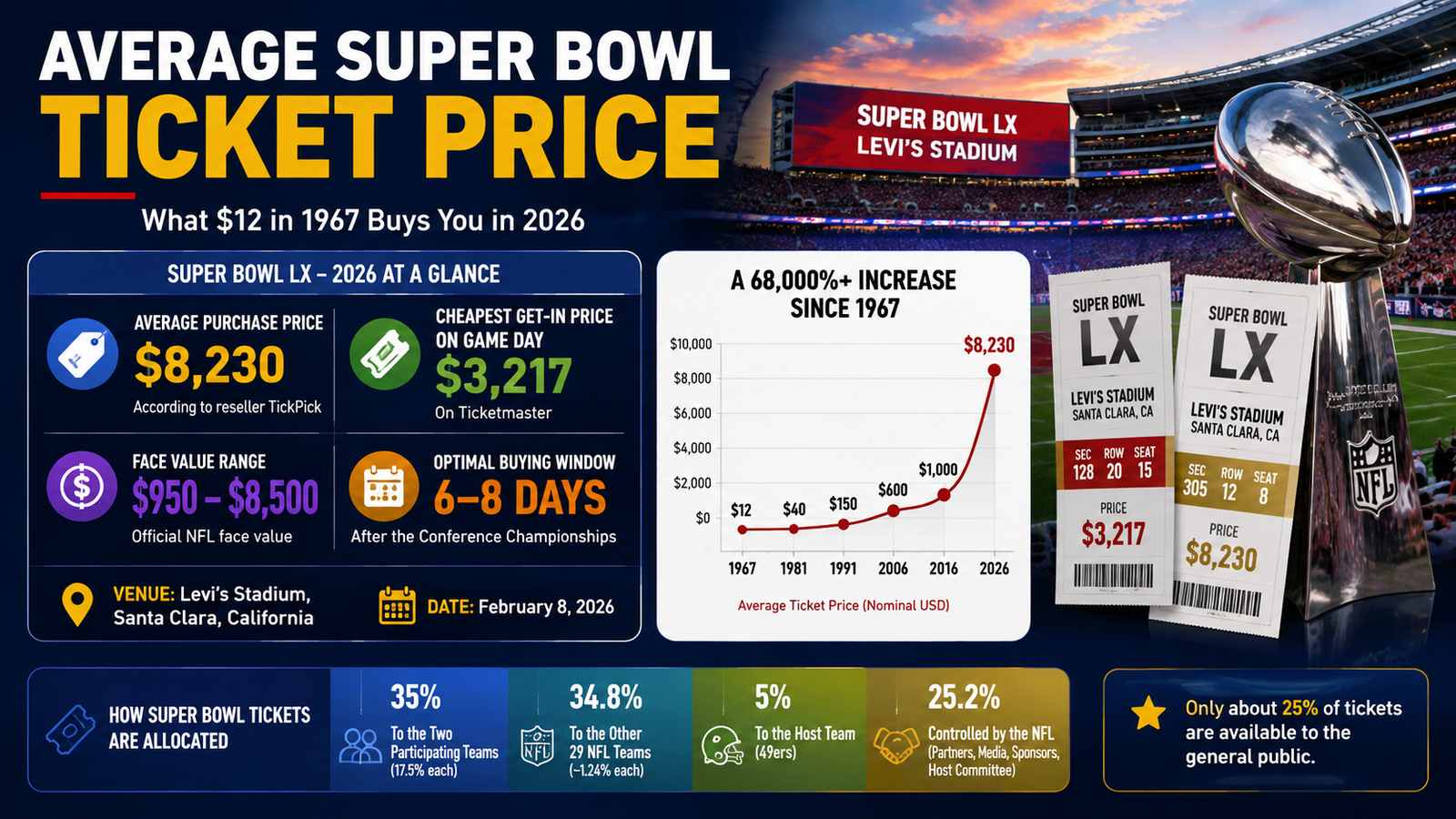
The average purchase price for a Super Bowl LX ticket is $8,230, according to reseller TickPick. The cheapest get-in ticket on game day dropped to $3,217 on Ticketmaster, while official face values ranged from $950 to $8,500.
$8,230
$3,217
$950–$8,500
6–8 Days After Conference Championships
Date: February 8, 2026
Venue: Levi’s Stadium, Santa Clara, California
Let’s cut through the noise.
The average Super Bowl ticket price for Super Bowl LX in 2026 sits at roughly $8,230, according to reseller TickPick. That makes it the second-most expensive Super Bowl on record, trailing only the 2024 Las Vegas game.
Here’s what the headlines won’t tell you: that average is a trap.
The real story is in the dispersion—between face value and resale, between get-in and VIP, between what the NFL wants you to believe and what the secondary market actually clears. And if you’re making a decision about attending, you need to understand the machinery behind these numbers, not just the number itself.
The $12 to $8,230 Pipeline: A 68,000% Story
The growth is absurd.
In 1967, a ticket to Super Bowl I cost $12. The game wasn’t even a sellout—30,000 seats sat empty in the Los Angeles Memorial Coliseum. Adjusted for inflation, that $12 is roughly $111 in today’s dollars.
So a ticket that should cost about $116—if the only variable were inflation—now averages $8,230. That’s a 7,000% real increase above inflation.
| Year | Face Value | 2026 Adjusted |
|---|---|---|
| 1967 (Super Bowl I) | $12 | $111 |
| 1971 (Super Bowl V) | $15 | $116 |
| 1981 (Super Bowl XV) | $40 | $137 |
| 1991 (Super Bowl XXV) | $150 | $345 |
| 2006 (Super Bowl XL) | $600 | $929 |
| 2016 (Super Bowl 50) | $1,000 | $1,305 |
| 2026 (Super Bowl LX) | $1,200 | $1,200 |
The narrative you’ll hear is “supply and demand.” The reality is more engineered.
The Allocation Mechanism: Why You Can’t Buy at Face Value
Here’s where the market gets distorted.
Levi’s Stadium holds approximately 68,500 fans for the Super Bowl. The NFL distributes tickets as follows:
- 35% to the two participating teams (17.5% each)
- 34.8% split among the other 29 NFL teams (about 1.24% each)
- 5% to the host team (San Francisco 49ers)
- 25.2% controlled directly by the NFL
That last bucket—the NFL’s direct allocation—goes to corporate partners, broadcast networks, media, sponsors, and the Super Bowl host committee. Only about one-quarter of tickets are available to the general public.
Face value for Super Bowl 60 ranges from $950 to $8,500. But here’s the kicker: almost no one pays face value.
The two participating teams each get about 12,450 tickets. Those go to players, coaches, staff, and a lottery for season-ticket holders. The average fan’s chance of buying at face value is effectively zero.
By the time tickets hit the secondary market, the face-value arbitrage is already captured by insiders. You’re not competing with other fans—you’re competing with corporate hospitality budgets.
The 2026 Market: A Tale of Two Prices
Here’s where the 2026 data gets genuinely interesting—and where the “average” becomes misleading.
The average purchase price (what people actually paid) was about $8,230.
The average list price (what sellers were asking) was $5,567.
That gap tells you something: sellers overpriced, buyers negotiated, and the market cleared lower than expected.
But the real action was in the get-in price—the cheapest ticket available.
| Platform | Cheapest Ticket (Early Feb) | Cheapest Ticket (Game Day Eve) |
|---|---|---|
| StubHub | $5,045 | $4,447 |
| Vivid Seats | $4,557 | $4,169 |
| TickPick | $6,322 | $4,288 |
| Ticketmaster | $7,230 | $3,217 |
| SeatGeek | $6,705 | $4,757 |
The get-in price dropped over 50% from late January to game day. The average ticket price fell from $6,657 on January 27 to $3,306 by game day eve—a more than 50% decrease.
Why Prices Crashed This Year
The 2026 Super Bowl market behaved differently. Here’s why:
1. The “Soft Market” Prediction
Before the matchup was even set, ticket analyst Scott Friedman predicted a “soft” Super Bowl ticket market. He noted that only Seahawks fans would bring a potential spike, while Patriots, Broncos, and Rams fans weren’t expected to create the kind of demand that drives up prices.
2. Patriots-Seahawks Is Not Chiefs-49ers
The 2024 Super Bowl (Chiefs vs. 49ers in Las Vegas) set the record at $9,800. The 2026 matchup—Patriots vs. Seahawks—didn’t carry the same juice.
3. Secondary Market Inventory Surge
A “recent push of newly available ticket inventory” hit the market after the conference championships, contributing heavily to price declines. By game day eve, just over 1,900 tickets remained available on the secondary market.
4. The Silicon Valley Factor
Levi’s Stadium is in Santa Clara—suburban tech territory, not a destination city. Unlike Las Vegas or New Orleans, there’s no built-in tourist infrastructure to absorb premium pricing.
What $8,230 Actually Gets You
Let’s get specific about what you’re buying.
The cheapest seats (400 level, end zone corners) started around $4,500-$5,000 in early February. That’s the get-in price—you’re in the building, but you’re watching on the video board.
100-level seats started around $6,500.
Midfield club seats hit $30,698—the most expensive single ticket on some platforms. On StubHub, the top ticket behind the Seahawks bench sold for $40,530.
And here’s the institutional insight: the highest-priced tickets are not the ones driving the “average.” The average is pulled up by a relatively small number of ultra-premium sales. Most transactions cluster in the $4,000-$7,000 range.
The Real Cost of Attendance: It’s Not Just the Ticket
Here’s what the average ticket price conversation misses.
For a family of four, concessions alone could run $200-$400 before you’ve factored in transportation or parking. And that’s before travel. If you’re flying in, booking a hotel, and eating out for the weekend, you’re looking at $8,000-$16,000 for the trip.
The ticket is the entry point. The weekend is the real cost.
When to Buy: The Institutional Playbook
If you’re serious about attending, here’s what the data actually says:
The best time to buy is typically 6-8 days after the conference championship games. The get-in price historically drops an average of 12% between Championship Sunday and Super Bowl Sunday—and 21% if you exclude the anomalous 2020 game.
The worst time to buy is immediately after the matchup is set. Prices spiked after the Patriots and Seahawks clinched, then corrected.
Game-day buying can work, but it’s a gamble. This year, the floor was around $3,217.
Monitor quantity available. As the number of tickets available goes down over the final days leading up to the game, prices begin to go up, especially for lower-priced seats.
The institutional play: wait for the post-matchup correction, buy in the 6-8 day window, and monitor inventory levels.
The Contrarian View: Are Super Bowl Tickets Actually Overpriced?
Relative to what?
A courtside NBA Finals ticket can hit $50,000+. A Formula 1 paddock club pass at Monaco runs $10,000+. The Super Bowl is the single biggest annual media event in the United States. Over 100 million people watch on TV. Only 70,000 get in.
By that metric, an $8,230 average isn’t irrational—it’s the market clearing price for exclusivity.
But here’s the institutional caveat: the Super Bowl is not a good investment.
Tickets are non-refundable. The experience is one day. The resale market is volatile—prices can drop 50% in a week. And the average fan who buys early often gets crushed by late inventory dumps.
If you’re buying to consume the experience, buy. If you’re buying to flip, don’t.
The 2026 Numbers: A Summary Snapshot
| Metric | Value |
|---|---|
| Average purchase price | ~$8,230 |
| Average list price | $5,567 |
| Cheapest get-in (early Feb) | ~$4,557 |
| Cheapest get-in (game day) | ~$3,217 |
| Face value range | $950-$8,500 |
| Stadium capacity | ~68,500 |
| Most expensive single ticket | $40,530 |
FAQs
1. Can you buy directly at face value?
Answer: Face value tickets are reserved for the NFL, which distributes them to all 32 teams. The only reliable way to buy at face value is through a team’s season-ticket holder lottery.
2. Are tickets refundable?
Answer: Standard secondary market tickets are generally non-refundable. Some platforms like TicketIQ offer refund guarantees if an event is canceled.
3. What are the best resale websites?
Answer: Ticketmaster (official partner), StubHub, Vivid Seats, TickPick, and SeatGeek are all legitimate platforms. Be wary of fraudsters posing as authentic sellers.
4. What about mobile ticketing?
Answer: All Super Bowl tickets are delivered via mobile transfer using the Ticketmaster app and NFL OnePass app.
5. How much are parking and hotels?
Answer: Parking at Levi’s Stadium ranges from $50-$150. Hotels in Santa Clara during Super Bowl weekend average $400+/night.
Key Takeaways
- The $8,230 average is misleading. The real entry price is $3,200-$5,000. The average is pulled up by a small number of ultra-premium sales.
- Face value is a myth. Almost no one pays the $950-$8,500 face value. The secondary market is where tickets actually trade.
- Timing matters more than budget. The best time to buy is 6-8 days after the conference championships. Buying early means overpaying.
- The Super Bowl is not a financial asset. It’s a consumption experience. Don’t buy to flip. Buy to attend.
- The real cost is the weekend, not the ticket. Travel, lodging, and food can double or triple your all-in cost.
Planning a trip to a major event? Check out our guides on ticket prices for top attractions and travel planning resources.
For more upcoming updates about hotels, trains, cruises, flights, destinations, holiday plans & tour packages, explore our NextDesti for all.






Leave a Reply