
One of the most common and affordable ways of travelling across the country is by train. The trains carry millions of passengers each day to their destination with a promise of safety and comfort. If you are travelling a short or long distance, knowing a train schedule will keep your vocabulary levels high and your problems low!
A schedule gives specifics of a train like its route, arrival and departure time, station-layover details, distance covered, and days on which it runs. It allows passengers to plan their journeys better and avoid last-minute issues by cross-verifying this information beforehand.
This guide informs you about train schedules — how they work and what information they feature, and says you will become familiar with the reason a train timetable is vital for every traveler.
What Is a Train Schedule?
A train schedule is a timetable that shows the complete journey details of a train from its starting station to its final destination. It includes the exact timing at each station along the route.
Passengers use this information to know:
- Departure time from the source station
- Arrival time at intermediate stations
- Arrival time at the destination station
- Duration of halts
- Running days of the train
- Total journey distance
- Travel duration
A train schedule acts as a roadmap for both passengers and railway operations.
Why Is a Train Schedule Important?
Many travelers underestimate the importance of checking train timings before starting their journey. However, it can save time and reduce travel-related stress.
Some major benefits include:
Better Travel Planning
Passengers can organize their travel plans according to train timings and avoid arriving too early or too late at the station.
Avoid Missing Trains
Knowing the exact departure time helps travelers reach the station on time.
Easier Connection Management
Passengers traveling through multiple routes can coordinate connecting trains more effectively.
Improved Time Management
A train schedule helps estimate the total travel duration and arrival time at the destination.
Convenient Station Transfers
Travelers can prepare for station changes and platform movements in advance.
Information Available in a Train Schedule
A typical train schedule contains several important details.
| Information | Description |
|---|---|
| Train Number | Unique identification number of the train |
| Train Name | Official name of the train |
| Source Station | Starting station of the journey |
| Destination Station | Final station of the route |
| Arrival Time | Time when the train reaches a station |
| Departure Time | Time when the train leaves a station |
| Halt Duration | Time the train stays at a station |
| Distance | Distance covered from the source station |
| Running Days | Days on which the train operates |
| Travel Duration | Total time required to complete the journey |
Understanding these details helps passengers make informed travel decisions.
Read More: Best Resorts in Manali / Agra To Jaipur Ticket Price / Delta Flight DL275 Diverted LAX
Components of a Train Schedule Explained
Train Number
Every train has a unique number that distinguishes it from other trains. This number is commonly used to search for train information.
Train Name
The train name helps passengers identify the service quickly. Popular trains often become well-known by their names.
Source and Destination Stations
The source station is where the journey begins, while the destination station is where the train completes its route.
Arrival Time
Arrival time refers to the time at which the train is expected to reach a specific station.
Departure Time
Departure time indicates when the train leaves a station after completing its halt.
Halt Duration
Some trains stop at stations for a few minutes. This stop is known as a halt.
Distance Covered
This section shows how far the train has traveled from its origin station.
How to Read a Train Schedule
Many first-time travelers find train timetables confusing. However, understanding them is quite simple.
Consider the following example:
| Station | Arrival | Departure | Halt |
|---|---|---|---|
| New Delhi | Start | 06:00 AM | — |
| Agra Cantt | 08:00 AM | 08:05 AM | 5 Min |
| Gwalior | 09:20 AM | 09:25 AM | 5 Min |
| Jhansi | 11:00 AM | 11:10 AM | 10 Min |
In this example:
- The train starts from New Delhi at 6:00 AM.
- It reaches Agra at 8:00 AM.
- It stays for 5 minutes.
- It departs at 8:05 AM.
This pattern continues throughout the journey.
Different Types of Train Schedules
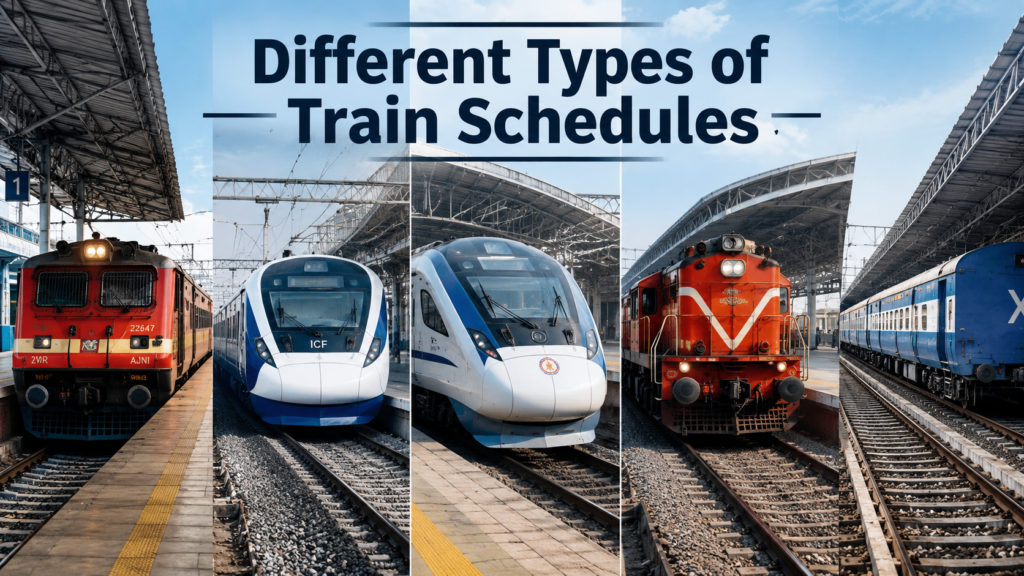
Railway systems operate various categories of trains. Each category has a different timetable structure.
Express Trains
Express trains stop at major stations and cover long distances efficiently.
Superfast Trains
These trains have fewer halts and higher average speeds.
Passenger Trains
Passenger trains stop at many stations and serve local travelers.
Intercity Trains
Intercity trains connect nearby cities and are popular among daily commuters.
Special Trains
These trains run during festivals, holidays, or peak travel seasons.
Factors That Can Affect a Train Schedule
Although railway authorities prepare detailed timetables, several factors can impact train operations.
Weather Conditions
Heavy rain, storms, fog, or extreme weather can affect train movement.
Track Maintenance
Railway tracks require regular maintenance to ensure safety.
Operational Delays
Technical inspections and operational requirements may occasionally cause delays.
Signal Issues
Signal-related problems can affect train movement and scheduling.
Increased Traffic
Busy railway routes often experience congestion, especially during holidays.
Common Terms Used in Train Schedules
Passengers frequently encounter certain railway terms while checking train information.
| Term | Meaning |
|---|---|
| Origin | Starting station |
| Destination | Final station |
| Halt | Stop at a station |
| ETA | Expected Time of Arrival |
| ETD | Expected Time of Departure |
| Route | Path followed by the train |
| Running Days | Days when the train operates |
| Distance Covered | Distance traveled from source station |
Knowing these terms makes it easier to understand train schedules.
Tips for Using a Train Schedule Effectively
To make the most of available train information, consider the following tips.
Check Timings Before Travel
Train timings may occasionally change due to operational requirements.
Arrive Early
Reaching the station 30 to 45 minutes before departure is generally recommended.
Verify Running Days
Not every train runs daily. Always confirm operating days before planning your trip.
Monitor Updates
Travelers should stay informed about any changes to train timings.
Keep Alternative Options Ready
During peak seasons, having backup travel options can be helpful.
Advantages of Understanding a Train Schedule
Passengers who understand train schedules enjoy several benefits.
Reduced Travel Stress
Knowing station timings reduces uncertainty.
Better Journey Management
Travelers can plan meals, rest breaks, and station activities more effectively.
Improved Punctuality
Passengers can avoid rushing and reach stations on time.
Easier Group Travel
Families and groups can coordinate their travel plans smoothly.
Enhanced Travel Experience
Good planning often results in a more comfortable journey.
Read More: Fred Olsen Cruises / Vande Bharat Mumbai to Goa Ticket Price / Expedia Hotel
Challenges Travelers Face Without Checking a Train Schedule
Ignoring train timing information can lead to several problems.
Some common issues include:
- Missing trains
- Arriving at the wrong time
- Difficulty managing connecting journeys
- Unnecessary waiting at stations
- Poor travel planning
Checking a train schedule beforehand helps avoid these situations.
How Railway Timetables Are Prepared
Creating a train timetable is a complex process.
Railway authorities consider:
- Route capacity
- Passenger demand
- Train speed
- Track availability
- Maintenance requirements
- Station infrastructure
The goal is to ensure smooth and efficient train operations across the network.
Future of Train Scheduling
Modern technology is making railway operations more efficient than ever before.
Advanced systems now help in:
- Real-time train monitoring
- Better traffic management
- Improved timetable planning
- Faster communication
- Reduced delays
These developments contribute to a more reliable travel experience for passengers.
Conclusion
One of the greatest treasures for railway passengers is a train schedule. It gives end-to-end information regarding train timings, routes, station stops, running days and time taken to reach the journey destination. Learning how to read and utilize a train schedule will enable travelers to plan their journeys seamlessly in order to reduce delays and travel hassle-free.
Whether you’re an occasional traveler or a frequent flyer, checking the train schedule before you begin your journey is always a good idea. This time is reduced, convenience is enhanced, and the experience throughout your travel journey from departure to arrival is prevented from being a nightmare.
FAQs About Train Schedule
1. What is a train schedule?
Answer: A train schedule is a timetable that provides information about train timings, station stops, routes, arrival and departure times, and running days.
2. Why should I check a train schedule before traveling?
Answer: Checking train timings helps you plan your journey better, avoid missing trains, and manage your travel time effectively.
3. What information is included in a train schedule?
Answer: It usually includes train number, train name, route, station list, arrival time, departure time, halt duration, running days, and total distance.
4. Can train schedules change?
Answer: Yes. Timings may occasionally change due to operational requirements, maintenance work, weather conditions, or special circumstances.
5. How can a train schedule help during long journeys?
Answer: It helps passengers estimate arrival times, plan breaks, manage connecting journeys, and prepare for station stops throughout the route.
For more upcoming updates about Hotels, Trains, Cruise, Flights, Destinations, Holidays Plans & Tour Packages explore our NextDesti for all.





Leave a Reply