
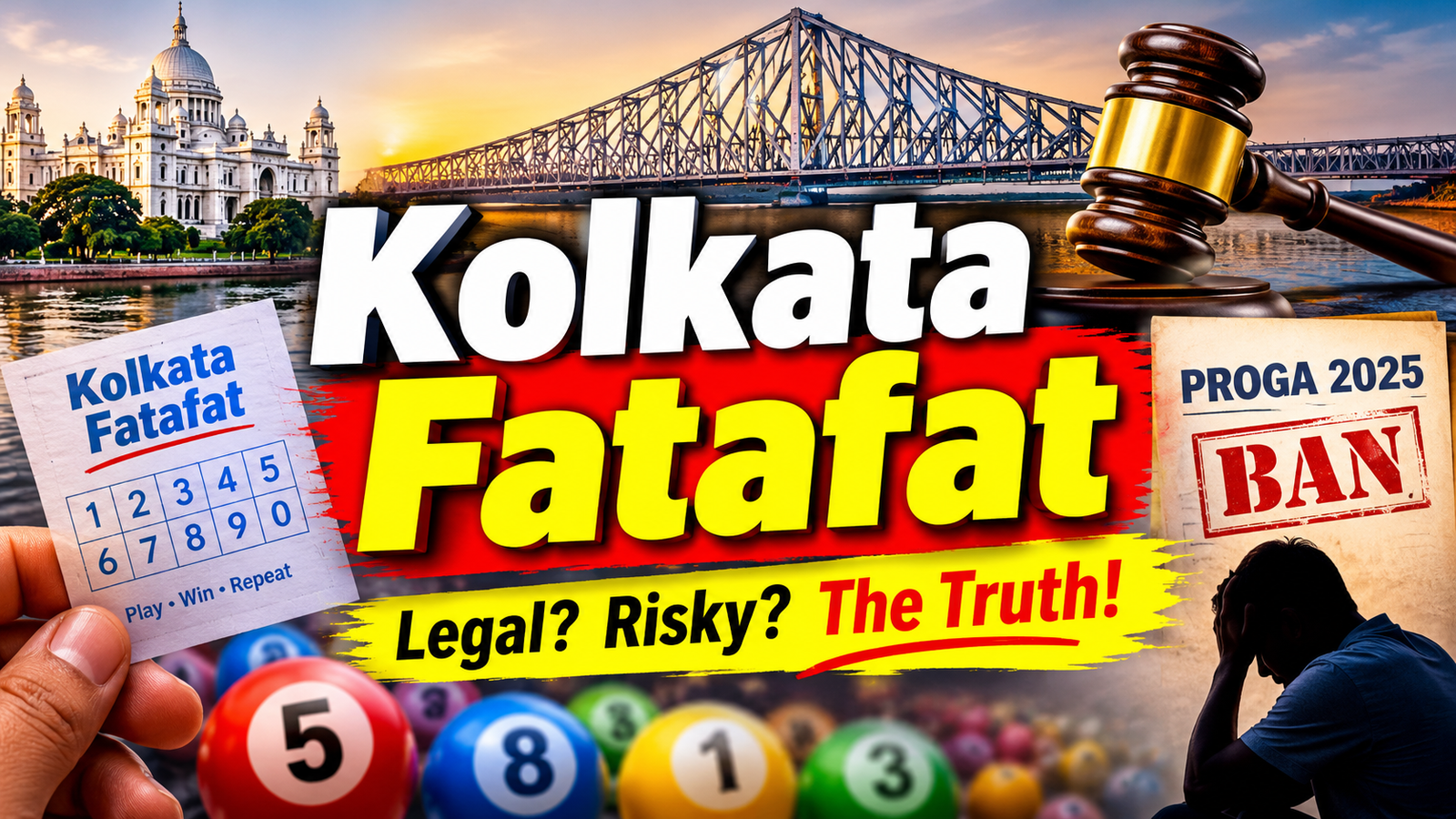
The first thing a market operator learns about Kolkata Fatafat is that the product is not the number. The product is the interval.
Eight draws a day. Ninety minutes between each. A result every time you refresh. That cadence is not a service to the player. It is a mechanism for extracting attention and stakes at a frequency that no casino floor can replicate. A blackjack table gives you a decision every twenty seconds, but you can walk away. Fatafat gives you a decision eight times a day, every day, and the infrastructure around it—the result sites, the Telegram channels, the “tips”—is designed to make walking away feel like the only thing you haven’t tried yet.
That is the operator’s insight the SEO-optimized “result today” pages will never give you: speed is not a feature of the game. It is the edge.
The Legal Question Is Not Grey. It Is Uncomfortable.
You will find sources that call Kolkata Fatafat “legal within West Bengal” and sources that call it “unauthorized gambling.” Both are citing something real, and that is precisely the problem.
The Statesman has described Kolkata Fatafat as a daily lottery operated under the jurisdiction of the West Bengal government. But the Directorate of State Lotteries—the actual nodal authority for government draws in the state—lists schemes like Bangabhumi Super Draw and Bangasree Super Draw, not Kolkata Fatafat. A game can be tolerated, policed, and even described as “legal” in local press without appearing on the official draw schedule. That is not a grey area in the philosophical sense. It is a documentation gap, and documentation gaps are where unsophisticated players get hurt.
Then came PROGA 2025, effective May 1, 2026. The Promotion and Regulation of Online Gaming Act imposes a nationwide prohibition on “online money games”—any game involving a financial deposit with the expectation of a monetary win—and carries first-time penalties of up to three years’ imprisonment and ₹1 crore in fines. The Act has been used explicitly to group Kolkata Fatafat alongside Gujarat FF and Kalyan Matka as targets of a “massive crackdown.”
Here is the contrarian read: PROGA did not kill Fatafat. It killed the alibi. The game always relied on a chain of local agents, handshake settlements, and plausible deniability. That chain now carries criminal exposure for operators and facilitators, and the financial plumbing is the weakest link. Banks have been mandated to use AI-driven protocols to flag and freeze accounts linked to illegal gaming networks—including accounts that merely received a UPI transfer connected to a mule account.
A player who thinks he is risking ₹50 on a single digit is, in 2026, also risking access to his legitimate savings. That is a different risk profile than the one the “result today” pages advertise.
The Payout Is the Marketing. The House Edge Is the Business.
Fatafat’s pitch is almost elegant in its simplicity: a single rupee can return ninety or more if you hit the right number. A correct patti—the three-digit combination—is typically quoted at around 150 times the stake. For a taxi driver in Howrah, a ₹50 bet on a single digit returns ₹500 if it hits. The math is small enough to feel survivable and large enough to feel like a way out.
That is the marketing. Here is the business.
The single-digit result is derived from a three-digit draw: add the digits, take the last digit of the sum. 780 becomes 15, and the single digit is 5. The draw is independent each round, and how the winning numbers are actually generated is not publicly documented. There is no auditable, transparent draw of the kind a government lottery uses. You are not betting on a probability you can verify. You are betting on a probability you have been told.
And the quoted odds are not the odds. A single-digit bet at 9:1 on a 0–9 draw implies a house edge of roughly 10% per round, before any consideration of how the draw is conducted. A patti bet at 150:1 against a 1-in-1,000 outcome implies an edge closer to 85%. These are not “low odds” in the abstract. They are structural transfers of wealth from the player to the operator, repeated eight times a day.
The speed compounds it. A player who bets ₹50 on four rounds a day is not making a ₹50 decision. He is making a ₹200-a-day decision, ₹6,000 a month, against a game with no verifiable randomness and no regulator watching the draw. The house does not need to cheat to win. It only needs the player to keep showing up for the next interval.
The “Tips” Economy Is the One You Should Read First.
If Fatafat were a game of skill, the people selling “exact numbers” would be playing it, not selling it. That is the oldest filter in speculative markets, and it applies with unusual clarity here.
Scammers on YouTube and Telegram claim to have “leaked numbers” or “Gosh Babu tips for Kolkata FF.” Fraudulent result sites have shown fake “winning” numbers to lure players into betting more, only to change the “official” result later. And the digital migration itself has inverted the trust structure of the game: the old local agent who lived in your neighborhood and settled in cash has been replaced by anonymous webmasters and Telegram admins who can vanish instantly, taking settlement money with them.
This is not incidental corruption. It is the predictable outcome of a product whose core input — the winning number — is unobservable and whose distribution is controlled by parties with a direct financial interest in the outcome. When the draw is unaudited and the operator is anonymous, the tip economy is not a side hustle. It is the natural interface between the game and the player.
The vulnerability is not random. Research on lottery participation in India consistently finds that lower- and middle-income households bear a disproportionate share of compulsive consumption, with the “dual burden of addiction and financial vulnerability” concentrated among economically weaker groups. Quick rounds and near-constant results encourage repeated play, and the psychological attraction is not a bug—it is the retention mechanism.
An operator does not call this addiction. An operator calls it engagement.
Read Also: Pictory AI Review 2026/ MaxxFour.com Review
What a Risk Framework Actually Looks Like (If You Insist on Playing)
I am not going to tell you there is a “smart” way to play a game with an unaudited draw and a house edge north of 10% per round. But a risk framework is different from a winning strategy, and the distinction matters.
Treat every stake as a sunk entertainment cost, not an investment. The moment you mentally book a potential payout as “money you can make,” you have already mispriced the product. The taxi driver’s ₹50 is not a seed. It is the price of ninety minutes of hope. Price it that way or don’t price it at all.
Never transact through a channel you cannot trace. In the PROGA environment, a UPI transfer to a personal account is not just a bet. It is a financial fingerprint that can trigger a freeze on legitimate savings. The compliance risk is now larger than the stake risk.
Distrust any result that is not corroborated across multiple independent sources. The indexer model—aggregating from multiple public sources and cross-checking for consistency — is the only sane way to read a number in an ecosystem where fake live results are a documented tactic. If you cannot verify the draw, you are not reading a result. You are reading a claim.
And understand the opportunity cost in speculative terms. The same impulse that makes a player chase a 90:1 single-digit payout is the impulse that makes retail participants overpay for lottery-like exposures in every market. Whether the ticket is a Fatafat bazi or a last-minute splurge on a [[last-minute splurge]] like [[the Wonderla ticket price]] or [[the Essel World Mumbai ticket price]], the behavioral mechanism is identical: small stakes, vivid outcomes, and a systematically underestimated probability of loss. The disciplined operator asks not “what could I win?” but “what is this costing me per unit of time, and what is the edge against me?”
The 2026 Verdict: The Game Didn’t Get Worse. The excuse did.
For years, Kolkata Fatafat operated in the space between “illegal” and “ignored.” That space is now closed. PROGA 2025 made the operator’s exposure cognizable and non-bailable, and the banking system became an enforcement arm. The draw was never audited. The tips were never real. The only thing that changed in 2026 is that the downside is now visible on your bank statement, not just in the ledger of a local agent.
If you play, play with money that is already gone. If you are looking for an edge, look at the people selling tips—they found the only reliable one. And if you are looking for a speculative outlet with transparency, audited odds, and a regulator who can actually see the draw, Fatafat is not a market. It is a treadmill with a payout, and the belt is moving faster than you are.
FAQs
1. Is Kolkata Fatafat a legal lottery in 2026?
2. What is the house edge in Kolkata Fatafat?
3. Can I go to jail for playing Kolkata Fatafat?
4. Why do “Kolkata FF tips” channels exist if they can’t predict the number?
Conclusion: The Only Edge Is the One You Refuse to Pay For
Kolkata Fatafat is not a mysterious game. It is a fast, unaudited draw wrapped in a distribution network that profits from your next refresh. The 2026 regulatory shift did not make the game more dangerous in itself. It made the existing danger legible — in fines, in frozen accounts, and in the collapse of the local-trust alibi.
Key takeaways: The product is the interval, not the number. The payout is marketing; the house edge is the business. The tips economy is the tell. And the only reliable operator’s move in a game with no auditable draw is to price the stake as a sunk cost or decline the trade entirely.
If you want a speculative outlet, demand transparency. If you want entertainment, price it like entertainment. And if someone offers you the exact number, ask yourself why they need your ₹500 more than they need their own.





Leave a Reply